What’s Laid Scrims
What’s Laid Scrims
Definition and Basic Structure of Laid Scrims
Manufacturing Process of Laid Scrims
The laid scrim is produced in three basic steps:
STEP 1: Warp Yarn Arrangement
Warp yarn sheets are fed from section beams or directly from a creel.
STEP 2: Cross Yarn Placement and Bonding
A special rotating device, or turbine, lays cross yarns at high speed on or between the warp sheets. The scrim is immediately impregnated with an adhesive system to ensure the fixation of machine- and cross direction yarns.
STEP 3: Drying and Final Processing
The scrim is finally being dried, thermally treated and wound on a tube.
Specifications of Our Laid Scrims
The specifications of our Laid Scrims:
| Width: | 500 to 2500 mm | Roll Length: | Up to 50 000 m | Yarns Type: | Glass, polyester,carbon | ||||||||
| Construction: | Square, tri-directional | Patterns: | From 0.8 yarns/cm to 3 yarns/cm | Bonding: | PVOH, PVC, Acrylic, customized | ||||||||
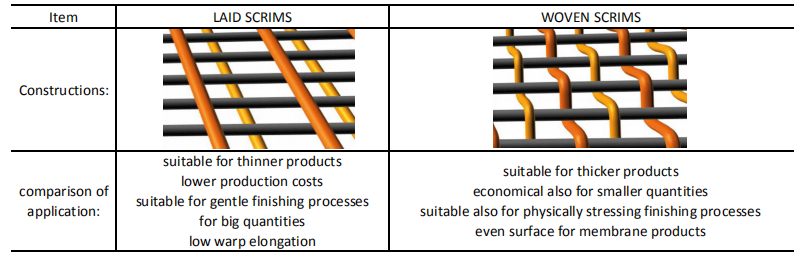
The differences of Laid Scrims and Woven Scrims:
The advantages of Laid Scrims
Lightweight Structure and Material Saving
Generally laid scrims are about 20 – 40 % thinner than woven products made from the same yarn and with an identical construction.
Many European standards require for roofing membranes a minimum material coverage on both sides of the scrim. Laid scrims help to produce thinner products without having to accept decreased technical values. It is possible to save more than 20 % of raw materials such as PVC or PO.
Thin and High-Performance Roofing Membrane Production
Only scrims permit production of a very thin symmetrical three layer roofing membrane (1.2 mm) that is often used in Central Europe. Fabrics cannot be used for roofing membranes that are thinner than 1.5 mm.
Smooth Surface and Better Appearance
The structure of a laid scrim is less visible in the final product than the structure of woven materials. This results in a smoother and more even surface of the final product.
Improved Bonding Performance
The smoother surface of final products containing laid scrims allows to weld or glue layers of the final products more easily and durably with each other.
Better Resistance to Dirt and Contamination
The smoother surfaces will resist soiling longer and more persistently.
Improved Production Efficiency
The use of glassfibre scrim reinforced nonwovens permits higher machine speeds for the production of bitumen roof sheets. Time and labour intensive tears in the bitumen roof sheet plant can therefore be prevented.
Enhanced Mechanical Performance
The mechanical values of bitumen roof sheets are substantially improved by scrims.
Tear Resistance Enhancement
Materials that tend to tear easily, such as paper, foil or films from different plastics, will be prevented from tearing effectively by laminating these with laid scrims.
Customized Bonding Solutions
Whilst woven products may be supplied loomstate, a laid scrim will always be impregnated. Due to this fact we have an extensive knowledge in respect to which binder may be best suited to different applications. The choice of the right adhesive may enhance the bonding of the laid scrim with the final product considerably.
Reduced Elongation and Improved Stability
The fact that the upper and lower warp in laid scrims will always be on the same side of the weft yarns guarantees that the warp yarns will always be under tension. Therefore tensile powers in warp direction will be absorbed immediately. Due to this effect, laid scrims often show a strongly reduced elongation.
When laminating a scrim between two layers of film or other materials, less adhesive will be needed and the cohesion of the laminate will be improved.
The production of scrims always requires a thermal drying process. This leads to preshrinking of the polyester and other thermoplastic yarns which will improve substantially subsequent treatments done by the customer.
Typical Constructions of Laid Scrims
Single warp
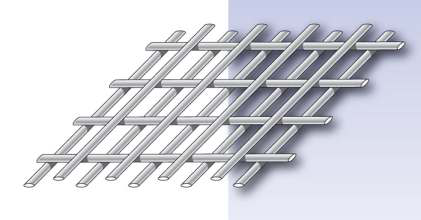
This is the most common scrim construction. The first warp thread under a weft thread is followed by a warp thread above the weft thread. This pattern is repeated across the whole width. Typically the spacing between the threads is regular across the whole width. At the intersections two threads will always meet each other.
warp = all threads in machine direction
weft = all threads in cross direction
Double warp
The upper and lower warp threads will always be placed one upon the other so that the weft threads will always be fixed between an upper and a lower warp thread. At the intersections three threads will always meet each other.
Scrim nonwoven laminates
A scrim (single or double warp) is laminated onto a nonwoven (made from glass, polyester or other fibres). It is possible to produce laminates with nonwovens weighing from 0.44 to 5.92 oz./sq.yd.
Why Choose RFIBER Laid Scrim Solutions?
RFIBER provides high-performance laid scrim solutions designed for various industries and applications, including waterproofing systems, composite materials, industrial products, and reinforcement applications.
With advanced manufacturing capabilities and flexible customization options, RFIBER supports global customers with reliable quality, stable supply, and professional technical solutions.
From standard products to customized reinforcement solutions, RFIBER is committed to helping customers improve material performance and create stronger composite structures.
Contact RFIBER today to explore the right laid scrim solution for your application.
Address
Head office Add: BLDG#26,MAX Technology Park Phase II,Baoshan District,Shanghai China
Factory Add: Shanghai Ruifiber (Fengxian) Industry Park, Fengxian, Xuzhou, China
E-mail
Phone
0086-21-56976143(Genral)
0086-21-56659615(Sales dept)
0086-1561815 6160
Hours
24-hour Service